How to Test Healthcare Marketing Without a Six-Figure Budget

A practical framework for testing consumer and HCP audiences before making a larger investment.
Healthcare marketers often face a difficult question: How much do we need to spend before we know whether a campaign works?
A national launch can require a substantial commitment before the team has answered more basic questions. Does the message connect? Are we reaching the right people? Does the landing page give them a compelling reason to act?
You do not need to reach everyone to start answering those questions.
A more manageable approach is to test one audience, in one setting, against one measurable action. Start with a defined pool of consumers or healthcare professionals, learn from their response, and use that evidence to guide the next investment.
Start With a Smaller, Relevant Audience
The goal is not simply to find the smallest audience. It is to find an audience that is relevant to your offer, reachable within your budget, and large enough to produce useful results.
For consumer campaigns, that might mean readers of condition-related content, people in a hospital’s service area, or an appropriately permissioned newsletter audience. For HCP campaigns, it might mean one specialty, one region, or a curated list of relevant NPIs.
These are six practical ways to create a manageable test:
| Smaller audience pool | Consumer example | HCP example | What it helps test |
|---|---|---|---|
| One geographic market | Adults in one metro or a hospital’s service area | Relevant clinicians in one state or region | Local demand and cost of response |
| One content category | Readers of articles about migraine, sleep or heart health | HCPs reading relevant clinical content | Whether the message connects in a relevant setting |
| One audience segment | Caregivers, older adults or parents | Cardiologists, primary care physicians or NPs/PAs | Which group responds best |
| One curated list | An appropriately permissioned newsletter audience | A defined list of relevant NPIs | Whether priority prospects engage |
| One publisher or small publisher group | Readers of a condition, wellness or lifestyle site | Readers of a specialty publication | Whether that media environment produces qualified visits |
| An existing engaged audience | Newsletter subscribers or other permissioned contacts | HCPs who requested information or attended a webinar | Whether an offer moves interested people to the next step |
Each pool answers a different question. A regional test can help assess local demand. A specialty test can help identify the most responsive HCP group. A contextual test can show whether a message attracts interest when it appears alongside relevant content.
Choose the pool based on what you need to learn.
Ask Three Questions, in Order
1. Does the message work?
Start with one relevant audience and compare two messages. Keep the audience, ad format and landing page consistent so the main difference is the message itself.
For a consumer campaign, you might compare a message about understanding symptoms with one about preparing for a conversation with a doctor. For an HCP campaign, you might compare a clinical education message with one emphasizing a practical resource.
Look beyond clicks. Which message brings visitors who engage with the content or complete the next step?
2. Who responds best?
Once you have a promising message, test it across two audience pools.
A marketer might compare primary care physicians with NPs/PAs, or run the same consumer campaign in two comparable markets. Keeping the message and destination consistent helps the team assess the audience difference.
Avoid dividing a modest budget across too many groups. Two adequately funded comparisons can teach you more than ten groups that each generate only a handful of visits.
3. Does engagement lead to action?
A click is an initial signal. The next question is whether that interest produces an action that matters to the campaign.
For consumers, that could be an appointment request, a provider search, or a discussion-guide download. For HCPs, it could be a resource download, webinar registration, or request to speak with a representative.
Define that action before the campaign begins. Then track both the number of completed actions and their cost.
Build the Budget Around the Learning Goal
Instead of asking, “How much should we spend on a launch?” ask, “What response volume do we need to evaluate this idea?”
A simple starting calculation is:
Target visits × expected cost per click = estimated media budget
For illustration, 300 visits at a $5 cost per click would require $1,500 in media spend. At a $20 cost per click, the same visit volume would require $6,000. These are hypothetical planning examples, not quoted rates, and exclude creative, setup and other costs.
The required budget depends on the outcome you want to measure. A few hundred visits may reveal an obvious engagement problem, but they may produce too few conversions to establish a reliable acquisition cost. At a 2% conversion rate, 300 visits would generate only six conversions.
Use early tests to identify promising directions and fix clear weaknesses. Budget for a larger validation test when the decision requires stronger evidence.
Keep the Test Focused
Before launching, write down five things:
- Audience: Who are we trying to reach?
- Question: What do we want to learn?
- Variable: What single element are we comparing?
- Action: What response will we measure?
- Decision: What result would justify continuing, revising or expanding?
For example: “We want to learn which of two messages generates more discussion-guide downloads among readers of migraine-related content. We will keep the format and landing page consistent and evaluate cost per download.”
That is a specific learning goal the team can evaluate.
Expand With Evidence
Smaller tests have limits. Reading an article about a condition does not establish that a consumer has that condition. An existing engaged audience may respond differently from people encountering a brand for the first time. A strong result in one region or specialty may not carry over nationally.
Those limits help define the next test. A promising result is a reason to validate the approach with another audience or a larger sample.
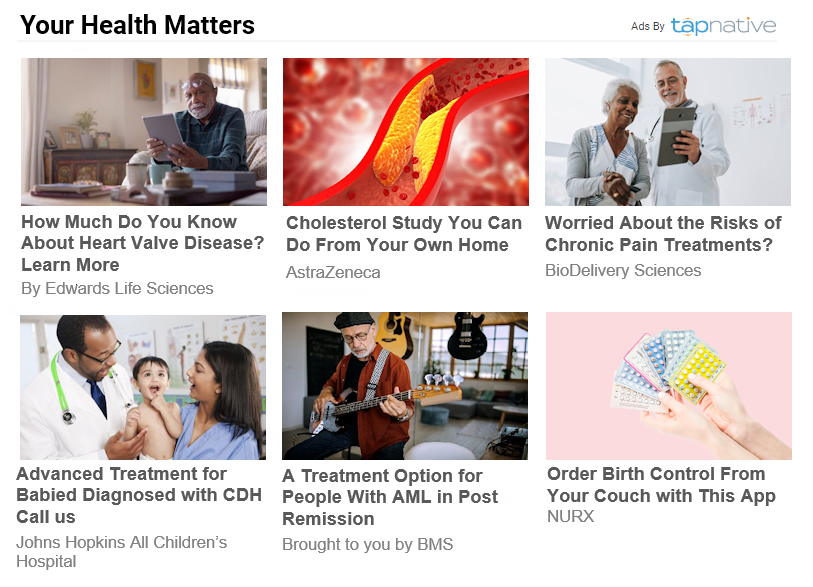
For marketers exploring native advertising, Tap Native offers consumer and HCP campaigns, including HCP targeting by specialty, geography and custom NPI lists. Those options can help teams define a focused starting audience before expanding their investment.
The principle is simple: Start with a small, relevant audience and a specific learning goal. Expand when the evidence supports the next investment.